Tuesday, June 2, 2009

Living the American Dream - in the U.S.!

On the way to the U.S. (Don't worry, the cards have either expired or are samples used as fridge magnets!)

Many of us have grown up dreaming of living the American Dream, including myself. As a teenager, I used to regularly play golf with a couple of American friends who were living with their families in England because their fathers worked with U.S. organizations based in London. At university when studying economics, I found that much of the economics literature was written by Americans, and while I at times dreamed of one day going there to live, it all seemed a little beyond my reach.

For our younger son, Morrison, the dream may be a little easier to realize than it was for me, since I did not first set foot in the United States until I was nearly 40. Morrison visited the U.S. for a few months when he was four, and then in 5th grade when he was 10 went there where he graduated from Kahakai Elementary School, Kailua-Kona, Hawai'i, and spent in total almost 8 years of his life in Hawai'i.
Morrison on a beach in Taitung, East Taiwan (photo taken by his brother James)

At the end of our time in Hawai'i, Morrison still had one more year of high school, and upon our return to Taiwan, things looked a little uncertain. Life was also a little hard for Morrison at that time, as he had to leave all his good friends in Hawai'i and complete his high-school studies by correspondence. Having been home schooled for almost all of his teenage years, would he be accepted into a U.S. college? There were also other things like SAT scores that he had to concern himself about. I myself had not paid much attention to these issues and even wondered if he could take these tests on Taiwan.
Morrison on Mount Alishan, Central/Southern Taiwan (photo taken by his mother)

When Morrison attended a small cooperative school in Hawai'i at around the age of 12, the teachers looked at each child and chose a character trait to describe what it was that each child had that caused him or her to excel. For Morrison, the character trait was "Determination". During the last two years in Taiwan, Morrison was certainly determined. In spite of a very laid back life in Hawai'i during his mid-teen years when his school performance was very so-so (homeschooling often seemed to be "no schooling"), Morrison's grades improved year by year and, even in subjects he found difficult, he managed to complete his assignments on time and get good grades. To prepare for the SAT test, he bought a large book full of practice tests and would sit in the local library for three hours at a time doing practice tests. While his written English (understandably) may have left a little to be desired, his Math scores got higher and higher.

Morrison applied to three U.S. colleges and was accepted by all of them. After careful deliberation, Morrison settled on Elmhurst College in Illinois where he will read for a B.A. in International Business starting this fall. Last week Morrison went to the American Institute in Taiwan to be interviewed for his student visa and now he has that, the next step will be to book a flight to Chicago some time in August.
Elmhurst College - Langhorst Football Field (Courtesy of the National Athletic Testing System)

Studying in the U.S. is not cheap, even though Morrison fortunately was able to secure a more generous scholarship than I had expected, given our circumstances. However, as a parent, I am confident that the money that I invest in Morrison over these next few years will be well worth it, as I know from being around him all these years that he is very careful with money, and he is also someone who can be entrusted with other people's money. In Hawai'i, a few of his friends for certain periods of time actually left some of their savings with him for safekeeping, to make sure that the money would otherwise not be spent when they were saving up for things like relatively expensive overseas trips.
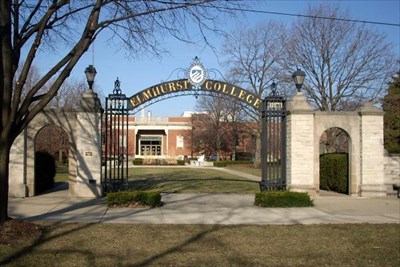
Elmhurst College, Illinois, established in 1871 as a seminary, and today offering a liberal arts education. About 10 miles from Wheaton College and about 40 minutes from the middle of Chicago.

Of course, just going to America does not guarantee success, and one can be successful in all kinds of places, particularly in Taiwan as I in a small way have discovered for myself. However, as anyone who has lived in the U.S. for a length of time will realize, the United States is a land of opportunity, a land that treats people with due respect, regardless of their ethnicity, color or religious beliefs, a land which values the liberty of the individual, and a land in which one can easily make a lot of friends.

As for me, the U.S. is a country that I feel I can be a part of without being one of its citizens (which I might well be if the process was a little easier!). During my eight years there, I could relate to what was going on, from the 9-11 tragedy, to Katrina, to the sporadic campus shootings, as well as to the more successful events like the return to earth of the space shuttle or the inauguration of the nation's first black president, Barack Obama. However, I am also European, and have lived much of my life (and continue to live) in Taiwan, and so I guess I will visit the U.S. for relatively short trips from now on. I hope that the next few years that Morrison spends in the U.S. attending college will be enjoyable and will help prepare him for whatever lies ahead, wherever that may be.
Morrison doing what he enjoys - skateboarding - somewhere in Southern Taiwan (photo taken by his brother or one of those with him at the time!)

Wednesday, May 20, 2009

Biking for Health and Pleasure

What does one need to enjoy biking on a regular basis? Well, a bicycle, I guess, but also a nice environment that is easily accessible from home in which to ride, relatively safe and uncongested roads, as well as dry and not too cold weather. In Niaosong, Kaohsiung county, it is possible to enjoy riding in this way. It takes less than 15 minutes to cycle from our home to this point on the edge of Cheng Ching Lake. In what follows, Jocelyn and I will show you that biking can be a rewarding and healthful experience.
If you are not too familiar with a bike course, a map is helpful and if you don't like carrying a map with you, one etched in stone by the roadside is just as good. This map describes the bike course around Cheng Ching Lake. One loop is a little under five miles. The red lines refer to an exclusive lane for bikes. This unfortunately does not extend the whole way round, but at least it's a start.
Since the bike course goes round a large lake, for about one-third of the ride (mostly downhill in this direction), one can see the lake to the right. Air temperatures close to large expanses of water like this are a few degrees lower, and the view is certainly good for the eyes.
When riding here it is not necessary to wear a face mask, although there are parts of the course, as well as parts of the ride to and from home, where one has to interact with quite a lot of traffic during rush hours. While this is part of the price that has to be paid for living in a big city, at least the contact with dust and internal combustion engines can be kept to a minimum.
To make the ride more pleasant, it is important to have good equipment. A bell is important as occasionally people are so taken in by the scenery that they fail to keep their eyes focused on what lies ahead of them, including oncoming cyclists.
The seat on the bicycle should be designed with the rider in mind, like this one was.
It is necessary to carry water on any bike ride, and the bike should have a bottle cage to allow a water bottle to remain firmly in place (as shown elsewhere), and accessed while on the move.
Bikes no longer come in "one size fits all". It is necessary to find the perfect fit for you. Giant bicycles in Taiwan have come up with a bicycle that is "women specific" and this particular model is designed for the smaller rider. This frame is made of aluminum.
With a good set of gears (in this case Shimano SLX), there are few hills (barring parts of Kaloko Drive in Kona, Hawaii) that one should not be able to ride.
Front suspension will make for a smooth ride when the going gets rough. Disc brakes appear to be the 'in thing", although I find the traditional types of brakes are just as good.

A mirror is a good investment, and saves one having to constantly turn one's head.
Lights are of course important at night, and a lubrication system built into the bicycle should keep the cables in good order.
A speedometer/odometer provides much valuable information on any ride.

About one kilometer into the ride, one passes three pavilions and one can also get a good view of the Grand Hotel on the other side of the lake.
The three pavilions area is an excellent place for watching the sunset. as the sun comes down on the opposite side of the lake as one looks out.
The Grand Hotel from a distance.
A bike helmet should be worn at all times even in warm weather. This one fits well (and is not cheap!) and has good air vents. Its white color is also less likely to absorb the heat.

Here one can see that the bike path is separated from the road by something resembling a 4"x4" piece of wood. The only criticism that could be leveled against the path is that is gets somewhat narrower than this in places, which might encourage some people to just ride on the road instead, which can of course be done, too.
As one turns at the bottom of the lake one sees a huge expanse of water. From this point on, one has to share the road with the other vehicles for about half a mile, but then after that there are more bike paths.
The Grand Hotel is a very famous piece of architecture in Kaohsiung and well worth a visit. After passing the hotel there are more rolling hills and relatively little traffic except in the height of the rush hour.
If one keeps following the route depicted on the map, one will eventually get back to where one started. Since this point where I (pictured) am standing is very close to the swimming pool, I not only biked today, but also swam about one mile in the pool, too. Not a bad workout. Maybe I could add in a short run as well.

Monday, May 11, 2009

A Different Mother's Day

This year, the day before Mother's Day, I found these roses at the local market. Before I gave them to my wife, Jocelyn, I took this photo of them as a souvenir.

Sometimes holidays give rise to conflicts of schedules, and being very busy these days, I am always a little apprehensive about participating in organized activities, for fear of falling even further behind schedule. Besides, on Saturday night the streets were packed with people going out to eat for Mother's Day, and I immediately imagined myself waiting at the entrance of some crowded restaurant on a noisy and traffic-congested street for more than an hour before we could get served.

So I heaved a sigh of relief when my family members suggested we go for a bicycle ride as a family on Mother's Day late in the afternoon when it would be a good time to take a break from the busyness of life, anyway. The idea was to more or less follow the river which runs only a few hundred yards from our house all the way until it hits the ocean at the other end of the city. In recent years, the local government has expended much effort in constructing bike paths, and it is more or less possible to ride on these paths for miles, usually next to a river (or a lake if one goes in the direction of where I swim in the mornings), with only minimal interaction with motorized transport.
We did not leave home until about 5:30 p.m., and after one or two detours (like where we were on the "wrong" side of the river and there were repairs being made to the bike path), we soon found that the otherwise bright and sunny day was quickly coming to an end. At this point looking down the river we were about two-thirds of the way to our destination (had we gone directly there).

We stopped close to where the Love River meets the ocean to take a few photos and decide on where we were going to eat. Like many of our trips, little had been planned. I kind of like things that way, i.e., a bit more spontaneous.

With less and less light, my little camera was becoming less capable of getting a clear shot, and fortunately James had his new camera with him, a Canon with a 30 mm F 1.4 lens, for those in the know.

As we waited there, the lights on buildings started to come on. I could still get a few reasonably good shots on my camera, because there was still quite a bit of daylight left.

However, without a a bigger and better camera, the above shot would not have been possible. I took it, although James set it up manually first. I should have brought a tripod.

In this picture we can see the four bikes we rode. Only mine on the far left, is a "real" bicycle. Even with gear on it and its much larger size, it still weighs a couple of kilos less than Jocelyn's bicycle. Maybe it is time to find Jocelyn a "real" bike.

After these pictures, we rode about another kilometer to the Fishermen's Wharf in Kaohsiung, which as its name implies is part of the port of Kaohsiung. (This was taken with my "little" camera, which was possible because the lights were very bright.) To get there were rode down a street full of small stores with names in various Asian languages, no doubt to serve the many foreigners who work on the boats.

This was the view (also taken with my camera) that we had as we ate a nutritious meal in an oceanside restaurant. However, instead of getting on one of these boats, we together rode (for about one hour) the 11 kilometers we needed to travel to get home, most of which was along the river and the nice bike paths built for this purpose.

Tuesday, April 28, 2009

The Impossible Dream

50 meters of outdoor pool open all year round

As I have been going to swim each morning, or at least most mornings, I have looked down the 50m pool and wondered just how fast I could swim a length if I especially trained for it. I remember in 1997 not long after recovering from illness that, at the end of a life-saving training session, I dived in another 50m outdoor pool in Taipei and swam the length in about 50 seconds. At the time, I told one of the instructors about it and he said that for us ordinary folk that was quite good, although of course for good swimmers it was really slow.

Now I can swim the same distance with a dive into the pool in about 40 seconds, and I often will have a go as I finish a 3,000 m workout and am warmed up for it. The world record is somewhere around 21 seconds (20.94 if Frederick Bousquet's recent record in France holds). For my age group, the qualifying time for USMS Nationals is apparently around 32 seconds. So getting my time down from about 40 seconds to about 32 seconds may be impossible or possible depending on which way you look at it.

I would really like to have the chance to qualify in some freestyle distance for the USMS Nationals. I think one of the main reasons is that there is a tendency for people to think that if you were not a good and fast swimmer when young, then you will never be able to become one when you are older. In my case, I did not break 50 seconds for this distance (LCM) until I was "over the hill" in my forties. In addition, in life I have had my share of setbacks and negative feedback, etc. and so to accomplish something, even if only small, will be all the more worthwhile.

So what have I got going for me? Besides having a pool to practice in (even though it is probably not a "fast" one), I have the advantage of height (1m 92s). While I still look like a shrimp compared with some of the "big boys" (who are often almost two meters and much more strongly built), at least I can get stronger through training, although I cannot make myself any taller. I also have fairly big feet and hands, which while a curse when one goes to a shoe shop, may possibly help if I can learn to use them to my advantage.

Currently, I am not very well coordinated on my 50m training "sprints". I can usually do a fairly good dive, but I am still experimenting with the dolphin kick (like they do in the big races) to get further up the pool before actually using my arms. Then I am not sure whether to take short, rapid strokes with my arms, or to fully extend them and take longer strokes with more glide. My breathing seems to be erratic, like 10 strokes then one breath, then 6 strokes, then 2 strokes, etc., etc. I can feel myself slowing down and struggling half way through the swim.

Well, all these things can be overcome, just as can flip turns. When swimming 100 meters where I need to turn, I can flip over so that I lie on my back as I push off the wall. However, often my push is so weak that I must have almost come to a complete stop.

Anyway, there are plenty of things I can work on, and it is well worth the effort. It is a great feeling to go down the pool and find out that a second was knocked off one's previous best time.
Another reason for focusing on the short distances is because in the past I have always tended to train for much longer distances. While I have developed a lot of stamina, I have always tended to be slow, and I could rarely pick up the pace in a short race (like a short Peaman or Mango sprint). So even if in the end I cannot reach the USMS qualifying standard, my overall performance in a "short" race with a swim of up to half a mile should be improved.
Second by second, pressing toward the goal

Wednesday, April 15, 2009

Swimming Alone in Taiwan

What do all these pictures have in common? The answer is that I am the only person in the 50 meter pool. This is a regular occurrence, since most of the few people that swim here are out of the water by 7:45 a.m. and I usually stay another half hour to "finish" my training. This is something I never could have dreamed of when I left Hawai'i almost two years ago - being able to swim all year round in a 50 meter outdoor pool, just 4.5 kms from our home mostly along quiet, scenic roads by bicycle, Kona weather all year round, except December and January when it is slightly cooler here, but still swimmable outside if one is mentally prepared for it. However, what about all this swimming alone?

Many years ago, I heard the story of someone who had stopped talking, not that he couldn't speak, but he felt that by not talking he would be less likely to say something bad and offend someone. Better to keep quiet than to start an argument or else be accused of being a gossip. Likewise, reclusivity may be a virtue. Just focus on yourself and live life for yourself, and spend lots of time training and reviewing your training.

Well, at times life may be like that (being on my own, etc.), especially after leaving Hawai'i and having to say goodbye to many good training buddies. There is the whole issue of culture shock when one relocates, not shock from an unfamiliar culture in my case (because I was just returning "home"), but having to start all over again, getting to know people, finding interesting things to do, etc., and discovering that people like those crazy friends that I trained with before don't seem to exist here (at least there are very few that I have the chance to meet).

Of course, nowadays we have blogs and Facebook, and so at least it is possible to keep in touch and share photos and video clips, etc. It is such an improvement over just using the telephone. And by keeping in touch, it is possible to plan trips to exotic places like Hawai'i to train and race with friends, and while a trip may be expensive, overall one still saves money as it is usually a lot cheaper living somewhere else the rest of the year.

As for my own training, in March I generally swam between 1,500m and 2,000m each day roughly six days per week, and this month I have upped the distances to between 2,000m and 2,500m per day. Not a lot, but I need to work harder this year than last as our boys are going to further their education overseas. While an extra 1,000m may not take that long in the water (even for me), I am more concerned about the onset of sleep later in the day when I am supposed to be getting things done. Still, I can't complain, I still feel as if I am retired, only that I have to be very careful with time.

I have benefited a great deal from the freestyle teaching video prepared by Karlyn Pipes-Neilsen, who continues to be a great inspiration as she breaks more Masters' records. My workouts start out with a longish warm-up, followed by relaxed sets as I slowly build up speed. However, instead of getting out once I have covered a certain distance, I usually like to finish with a 100m or 50m at at least 90 percent effort. That is the highlight of the day, and puts me in good stead for the work I do later in the morning, which requires a lot of mental concentration.

I have recently made friends with a cardiologist I see at church. Don't quote me on this, but when I asked questions like: "Will I have a heart attack as a result of going flat out on a 50 meter sprint?" he appears to be of the opinion that as long as I train regularly this would be extremely unlikely, and when the unimaginable does happen, it may be due to a problem with the heart that existed at birth. Anyway, it is important to train regularly and consistently and to warm up well at each workout. I have not had any shoulder discomfort this year and had very little last year even with longer distances.

In closing, after writing this, I am not so keen on becoming a recluse, and I do have a few good swimming friends here - someone had to take the pictures. So while it may not be so easy to train together, at least we can train and follow each others' blogs and maybe have the chance to race against each other in the not-too-distant future.
The pool is occasionally used by other people, like this Saturday morning. The children are mostly in elementary school and belong to a swim club. They are training for a meet and are all pretty good.

Wednesday, March 18, 2009

Alishan's Cherry Blossoms 阿里山的櫻花季

On March 9 & 10, we went on a family trip to Alishan in Chiayi County in central/southern Taiwan. Well, it was supposed to be a family outing, but James sprained his foot badly the day before and the doctor advised him to stay home. So just three of us went. We can always go again some time.
The real start to our adventure, as you will see below.
This little diesel train, and another further up the hill, were going to spend the next four hours transporting us to our destination.
The early stages of the train ride. Normal weather and plenty of betel nut trees (a cash crop that is not environmentally or medically friendly).About half way (a little above one thousand meters) and above one set of clouds. Morrison is already warmly dressed.

Somewhere in the middle of the trip we had to change trains which involved a 15-minute walk over hilly and muddy trails - all because of a landslide some time ago that broke the line in two.

As the afternoon wore on, we would occasionally see some nice cloud formations (now about 1,600 meters)

After we reached the end of the journey and our hotel at 2,200 meters and about 7 degrees celsius, we went out to eat our evening dinner - hot pot!The next morning we were up early and joined a prearranged tour that would take us to see the sunrise.

Two of the many sacred trees that we saw during our stay.

We were fortunate to see the sun as not every morning is clear.
The scenery up here (at 2,700 meters) is a lot different from what one usually has at sea level.
Some trees made people look like midgets.
The cherry blossoms that we saw later the same morning were the highlight of our trip, the icing on the cake as it were.

Hsiu-chin even had the clothes to match!
Many people have seen Christmas trees with lights, but they cannot compare with a Tokyo cherry tree like this. (To see the flowers more clearly, click to enlarge image.)

This tree was located next to the Alishan hotel (which we did not stay at, but would consider doing so another time)
These blossoms are unbelievable (thanks Morrison for the pic)
Blossoms by the roadside.

There are trees everywhere and also a lot of blossoms.Two generations at the three-generation tree.

Certainly a nice place for a walk! We did not have a lot of time, unfortunately, at at this point we had to make plans to get back the the hotel to check out.
The 21st largest tree in the forest here. This one is still standing.
This sacred tree, after a life of two thousand years, in recent years (with the help of an earthquake) finally bit the dust. One wonders of the struggles that the ones still living are having to face just to survive in this day and age.
Sadly, the prearranged tour had us taken down the mountain in a 9-seater van. Had I been traveling the usual way I travel, I would have just got on this train instead (at Fenchihu station).
After we go back to the old Chiayi station, we caught a bus which took 20 minutes to reach Chiayi's high speed rail station. Then, we rode the shinkansen for 35 minutes. After another 10 minutes we were back home. I really think we need to go again. We did not see it all.